LIFE-SAVING IDEAS (1/5)
52 IDEAS FOR LIVING BETTER, TOGETHER AND SUSTAINABLY
"What if we had to protect freedom of expression from itself?"

I came across this book in a book review in Le Monde mid-March, ordered it (i a real bookstore) and swallowed it in a couple of weeks. In 52 pieces divided in 5 parts, the author goes through a wide variety of life themes, with a pragmatic, constructive a mostly positive point of view. One of the pieces talks about meliorism, the philosophical doctrine, that the world can be improved through human effort. To me, it is the word that best reflects the feeling, that I got reading the book. After having contacted the book's editor, I got the authorization to re-publish 5 of the 52 pieces of my choice as well as the intros of the different parts. As the book is not yet translated to English, I can only strongly recommend it to our French-speaking readers. It's a boost! Now, for once, instead of doing my own summary, I just publish it as in the book. I will do this on a weekly basis, the first piece, that I've chosen "What if we had to protect freedom of expression from itself?", being one of part 1, called "To awaken our conscience of the World". The other four parts are :
Rethinking our ways of thinking
Repairing the thread of generations
Rehabilitating the gentleness of life
Activating our power to act
I will, in the same spirit, publish one piece of each of these four parts weekly in the four coming weeks.
Let's start by giving the word to the author, Nicolas Bordas, who, surprisingly to me (sorry Nicolas), as I'm not near Communication or Ad agencies, is well known among my friends, and who was the CIO of TBWA France...
To be totally aligned, I just republish his Intro to his work below, before the first piece, below.
Enjoy!
Introduction
What if ideas that kill were ideas that save lives?
“Nothing is more powerful than an idea whose time has come.”
VICTOR HUGO
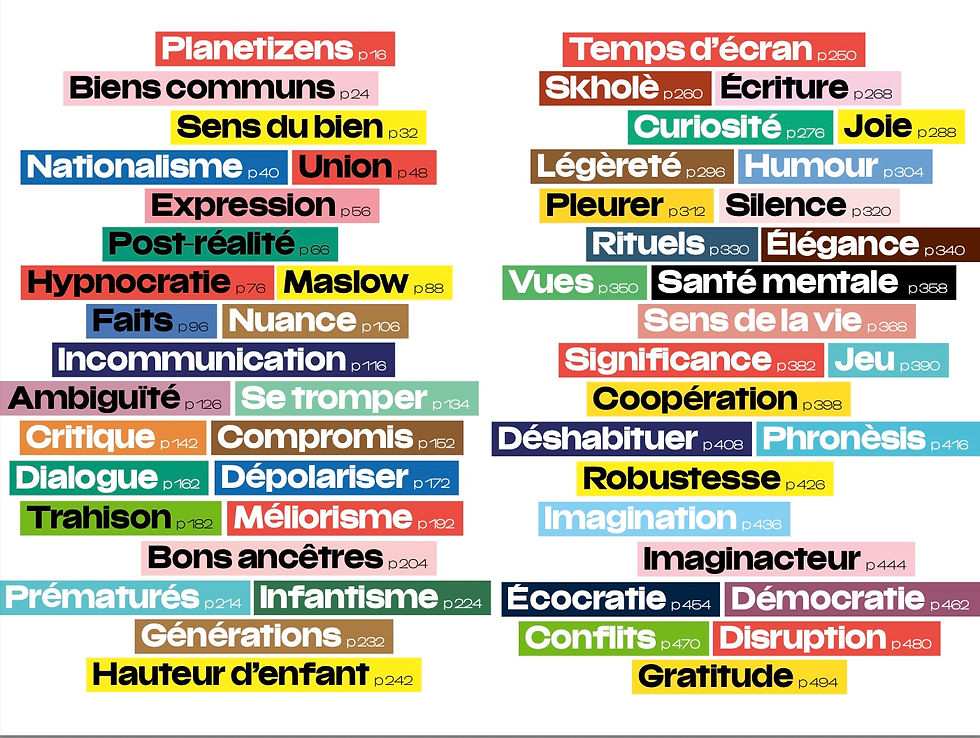
It all began with an intuition. Or rather, a conviction: only ideas have the power to change the world, because all our actions are the fruit of our ideas. Not the flashy opinions, not the flattering slogans, not the ready-made formulas. But true ideas. Those that enlighten and question. Those that shift and transform. Those that uplift and help us grow. For years, I worked in the world of communication, marketing, strategy, education, and politics. I saw thousands of ideas come and go. Some hollow, others brilliant. Some born to please for a moment, others made to last. I learned to recognize their power, their ability to shape imaginations and influence reality. In my first book, *The Killer Idea!*, I sought to understand why an idea takes hold—or doesn't. How an idea becomes viral, unforgettable, irresistible, even transforming into an ideology. I explore the role of narratives, emotions, and symbols. I discuss politics, advertising, society, and religion. But beyond identifying the reasons for success or failure, I remain obsessed with a single question: how can each of us help ideas that work for the common good to succeed? To achieve what the philosopher Edgar Morin calls "metamorphosis." Because the more uncertain, fragmented, and vulnerable the world becomes, the more crises follow one another, the more our points of reference collapse, the more attention is scattered, the more cynicism takes hold, and the more we need ideas. Clear ideas to understand. New ideas to invent. Powerful ideas to act. Ideas that don't kill life, but that kill resignation. Ideas that don't divide, but that unite. Ideas that don't simplify the world, but that help us inhabit it differently. That's why, in 2023, I launched a weekly newsletter on LinkedIn called "The Killer Idea!" Each week, I start with a theme, often related to a book, and an author whose central idea I rephrase as a question: "What if...?" This "What if...?" isn't rhetorical. It's a tool. A crack in reality. A step aside. It opens a breach in our certainties. It proposes an alternative path. It doesn't impose anything, but suggests as much as possible. In two years, more than a hundred ideas have been brought to light. Some have made us smile, others have shaken things up. Many have sparked discussions, debates, and further exploration. And it's from this abundance that this book was born, at the suggestion of Isabelle Musnik, co-founder of the media outlet Influencia. WHY A BOOK, WHEN EVERYTHING IS ALREADY ONLINE? Because a book provides coherence. Time. Depth. It allows for unfragmented reading. It charts a course. It allows for in-depth reflection on what a newsletter sometimes only touches upon. From all the newsletters already published, Isabelle Musnik helped me select the fifty-two most stimulating and transformative ideas. One for each week of the year to maintain the weekly rhythm of my newsletter. Five major themes emerge, corresponding to as many necessities, not to say emergencies, of our time:
Awakening our global awareness: broadening our perspective, thinking globally, understanding interdependencies, and reclaiming control over dominant narratives.
Rethinking our ways of thinking: restoring nuance, listening, and dialogue, and rediscovering the value of democratic debate in a world saturated with oversimplifications.
Repairing the threads between generations: rebuilding bridges between ages, valuing transmission, and rekindling our connection to childhood, to long-term perspectives, and to memory.
Rehabilitating the gentleness of life: restoring the place of emotion, beauty, silence, and acts of care; rebuilding a sensitive and relational ecology.
Activating our power to act: encouraging engagement, cultivating transformative imagination, and prioritizing resilience over the cult of performance.
Each sequence begins with a brief introduction, like a breath, a compass. Each idea is formulated as a question, because I believe more in doubt than in doctrine. Each story is based on a book, a situation, or an encounter that sparked it. I reworked most of the originally published texts to adapt them to the book format. Each chapter features an original illustration designed by art director Olivier Marty.
A BOOK AGAINST READY-MADE THINKING
This book is neither a manifesto, nor a program, nor a theoretical treatise. It is a work of living ideas. It is permeated by paradoxes, tensions, and open questions. It doesn't offer lessons. It doesn't have all the answers. It simply aims to put "thinking for oneself" back at the heart of the experience that each and every one of us can have. We live in a paradoxical age. Never before have we had so much information, yet we struggle to think. Never before have we had so many tools to communicate, yet we understand each other so poorly. Never before have we been so connected, yet we lack deep connections.
The ideas that follow are not intended to fill this void, but to inhabit it differently. They do not claim to save the world. But they can, perhaps, help us find a little clarity in the fog. A little breath in the saturation. A little courage in the pervasive weariness. And contribute to preserving our shared humanity.
WHAT IF IDEAS BECAME A FORM OF HEALING?
There is something therapeutic in the act of thinking. Not thinking to escape the world, but to better engage with it. Thinking to make ourselves available. To reorient ourselves. To find meaning in a world that so desperately lacks it. Thinking is also a way of caring: for ourselves, for others, for the planet. A just idea, a fruitful idea, a human idea can have concrete effects, visible or invisible. It can mend a bond, defuse a conflict, spark a vocation, inspire a decision, save a relationship. This is not about romanticizing ideas. It's more a question of restoring them to their rightful place. Because history has shown that ideas can kill. But they can also save. Everything depends on their nature. Their intention. Their use. And above all, their potential.
WHAT IF YOU, IN TURN, BECAME A CARRIER OF IDEAS?
This book wasn't designed to be read passively. It's meant to spark reactions, resonances, and extensions. It can be read in order or at random. It can be discussed, challenged, and rewritten. It can also be passed on. Each chapter is a seed. It's up to you whether you want to sow it, water it, and make it grow. It's up to you to decide if it deserves a conversation, a reflection, or an action. It's up to you to imagine what comes next… In a world that moves too fast, reading an idea slowly is already an act of resistance. In a world saturated with noise, sharing is already an act of influence. In a world that doubts itself, still believing in the power of ideas is already an act of faith. So, what if you started now?
The first idea sets the tone. It speaks of the planet, of consciousness, of global citizenship. Perhaps this is where it all begins. And the last one, like a whispered thank you, reminds us of something we too often forget: saying thank you is a life-changing idea.
Enjoy your reading. Have a good journey.
And above all: good ideas (that save lives)!
Part 1
Awakening Our Awareness of the World
Sometimes the world becomes blurred. Not that it disappears. But it becomes hazy, confused, elusive, as if seen through a moving pane of glass. Stories collide. Images accumulate. Everything accelerates. Nothing becomes clear.
We live connected without always being in touch. Surrounded without being together. Informed without understanding. Caught in a planetary simultaneity that engenders neither the hoped-for solidarity nor the expected responsibility.
So we must slow down and re-examine our relationship with the world, in order to find how to inhabit it better.
For there is no transformation without lucidity. And no lucidity without a slight shift in perspective. This step aside, this shift in perspective, is what the first part of this book proposes.
It is not about creating a grand narrative. Nor about explaining the world once and for all. But rather, it's about opening up new perspectives. Questioning what we took for granted. Learning to see differently what surrounds us, and sometimes what surpasses us.
Looking the world squarely in the face. In its tensions, its fractures, its promises. Naming what divides us without abandoning what unites us. Reconciling here and elsewhere, near and far, lucidity and hope.
Being planetizen, as the neologism in the first chapter suggests, is not just a state of mind: it's an inner disposition that aims to inhabit reality without fleeing from it, without excluding, without abandoning what is common.
This first section addresses the major contemporary upheavals, whether climatic, political, technological, or cognitive. It offers disruptive ideas as starting points to reopen our awareness of the world. Not to close things off, but to initiate. Not to judge, but to try to understand better. For it is by awakening this awareness of the world that
we can hope to learn to think better, communicate better, feel better, and act better.
As I mentioned above, I have therefore chosen the sixth text from this first part for this week (Mikael's note).

or "What if we had to protect freedom of expression from itself?"
We often hear people say that "you can't say anything anymore". The times have become timid, public debate is stifled, censorship is omnipresent.
This complaint, endlessly repeated in the media and on social networks, rests on a myth: that of an absolute, sacred, untouchable freedom of expression, supposedly betrayed in the name of political correctness. However, as the legal scholar Thomas Hochmann demonstrates in his book *On ne peut plus rien dire* (We Can No Longer Say Anything), it is precisely this illusion of absolute freedom that threatens democracy today. For while freedom of expression must remain a fundamental pillar of public life, it cannot survive without the responsibility that accompanies it. It must sometimes be protected from itself, from its excesses, its perversions, its manipulation, in order to preserve what is most precious about it: its function of dialogue and truth. To understand this paradox, we must first recognize that freedom of expression has never been the same from one society to another. In the United States, it is established as a near-absolute principle: in the name of democratic pluralism, even hate speech or lies are tolerated. In France, it is regulated by law, which sets limits to protect public order, human dignity, and collective memory. In the rest of Europe, the situation is even more nuanced: freedom of expression is guaranteed by the European Convention on Human Rights, but it can be restricted when it conflicts with other fundamental rights such as protection against hatred, respect for privacy, or the prevention of abuse. In other words, freedom of expression, as conceived by European societies, is not absolute: it is proportionate, contextualized, and subject to the public interest. And it is precisely this tension between freedom and responsibility that underpins its democratic value.
FREEDOM OF EXPRESSION, THE BACKBONE OF DEMOCRACY
What unites these different legal traditions, however, is the conviction that freedom of expression is vital to democracy. In any free society, citizens must be able to express their opinions, criticize those in power, debate their views, and invent new ways of seeing the world. Without this freedom, there is no independent press, no political debate, and no social or scientific progress. This idea goes back to the very foundations of modern liberal democracies: John Milton already defended the right to publish without prior censorship in the 17th century. John Locke and Voltaire established tolerance and freedom of opinion as a bulwark against religious and political absolutism. In 1859, John Stuart Mill, in On Liberty, emphasized the necessity of allowing even false ideas to be expressed, which, he said, are useful because they force true ideas to justify themselves, to refine themselves, and to remain relevant. Hannah Arendt reminded us that free speech is the foundation of the democratic public sphere, where citizens appear as equals. More recently, Jürgen Habermas has shown that democracy rests not only on voting, but also on reasoned deliberation, made possible by open and responsible freedom of expression. In this sense, freedom of expression is not a luxury, nor even an individual right, but rather the very condition for the possibility of democratic life. However, this freedom, fundamental as it is, cannot be considered an end in itself. It must be used to serve a collective purpose in order to foster the formation of sound, pluralistic judgments accessible to all. This is where tensions arise, because toxic, deceitful, or hateful speech, far from illuminating the debate, can instead obscure it, disrupt it, or exclude some participants. This is the whole challenge of our time: to defend freedom of expression without naivety, taking into account the concrete conditions of its exercise, its uses and its effects in the contemporary public space.
THE EXCESSES OF A TOXIC FREEDOM
This demanding conception of freedom of expression, as a tool for deliberation and collective progress, finds a radical form in the American model, where this right is elevated to a cardinal, almost sacred, value. The First Amendment to the Constitution prohibits any law restricting freedom of speech, and the Supreme Court's jurisprudence has consistently upheld a maximalist interpretation of this principle. Since the Brandenburg v. Ohio decision in 1969, only speech inciting imminent violence can be punished. Everything else—racist, Holocaust denial, and conspiracy theories—remains permissible, in the name of the state's neutrality toward ideas. This approach rests on a liberal faith deeply rooted in the "marketplace of ideas," theorized by Oliver Wendell Holmes Jr. and later taken up by Alexander Meiklejohn and Ronald Dworkin. According to them, even the most absurd statements must be given a voice, so that truth may emerge from confrontation. Censorship is seen as more dangerous than error, and public debate is considered a space for experimentation and resistance to dogma. This tradition has fostered a culture of radical pluralism, where the clash of opinions is perceived as the driving force of democracy. But today, this model is showing its flaws. In a saturated media ecosystem, where social networks amplify the most extreme rhetoric, the belief in the self-regulation of debate is eroding. Hate speech is no longer marginal, but is becoming virulent, viral, and pervasive. When completely unregulated, freedom of expression can be used as a weapon against itself: it allows disinformation, manipulation, and radicalization to flourish, weakening the very conditions of rational debate that it claims to protect.
FREEDOM OF EXPRESSION AS A SHARED RESPONSIBILITY
Thomas Hochmann proposes a true reversal of perspective in *On ne peut plus rien dire* (We Can No Longer Say Anything). Far from seeing legal restrictions as a betrayal of freedom of expression, he sees them, on the contrary, as a prerequisite for democratic possibility. For him, freedom of expression is neither an end in itself nor an abstract absolute. It is a means at the service of public debate, a lever for circulating ideas, confronting opinions, and guaranteeing the inclusion of all in collective deliberation. For this debate to take place, it must not be diverted, drowned, or stifled by forms of discourse that prevent any real discussion. Hate speech, defamation, and systematic disinformation do not contribute to democratic exchange; they degrade it. They do not open up the public sphere; they close it. They do not expand freedom; they curtail it. The Covid-19 pandemic starkly illustrated this paradox: under the guise of freedom of expression, medical fake news circulated widely on social media, contesting the reality of the virus, denying the effectiveness of vaccines, or promoting ineffective miracle cures. Far from enriching democratic debate, this rhetoric sowed confusion, fractured society, and jeopardized public health policies designed to save lives. This kind of abuse demonstrates that freedom of expression, if not guided by a commitment to truth, justice, and responsibility, can turn its own principles against itself. In this respect, Thomas Hochmann offers a legal, but also profoundly political, interpretation of freedom of expression: it is not a right to harm, but a right to contribute. To guarantee this right to all (and even to those at risk of being silenced by verbal or symbolic violence), it is sometimes necessary to impose limits. Not to censor, but to protect the shared space of democratic speech. From this perspective, French laws (against defamation, incitement to hatred, Holocaust denial, etc.) are not attacks on freedom of expression, but guarantees of its effectiveness for all. More broadly, the entire European model, founded on proportionate and contextualized freedom of expression, appears as a path to balance. A path that sacrifices neither criticism nor responsibility, but seeks to maintain the very possibility of speaking freely, honestly, and humanely. In a world saturated with words, images, and opinions, defending freedom of expression means refusing to let it serve as a smokescreen for hatred, intimidation, and organized lies. It means recognizing that speech is not neutral, that it affects others, that it structures the shared space, that it can exclude as well as invite. And that guaranteeing the right to speak is not only about protecting those who speak out—it is above all about giving a voice to those whom attempts are made to silence. Faced with populism, digital radicalization, and viral manipulation, it is not a question of renouncing freedom of expression. On the contrary, it is urgent to save it from its most toxic excesses by reaffirming that it is inseparable from truth, justice, and respect for others. This is not a regression. It is a necessity. For there is no lasting freedom without shared responsibility.
“Everything that increases freedom increases responsibility.”
VICTOR HUGO


Comments