LIFE-SAVING IDEAS (2/5)
"WHAT IF WE RECONNECTED WITH THE ART OF COMPROMISE?"
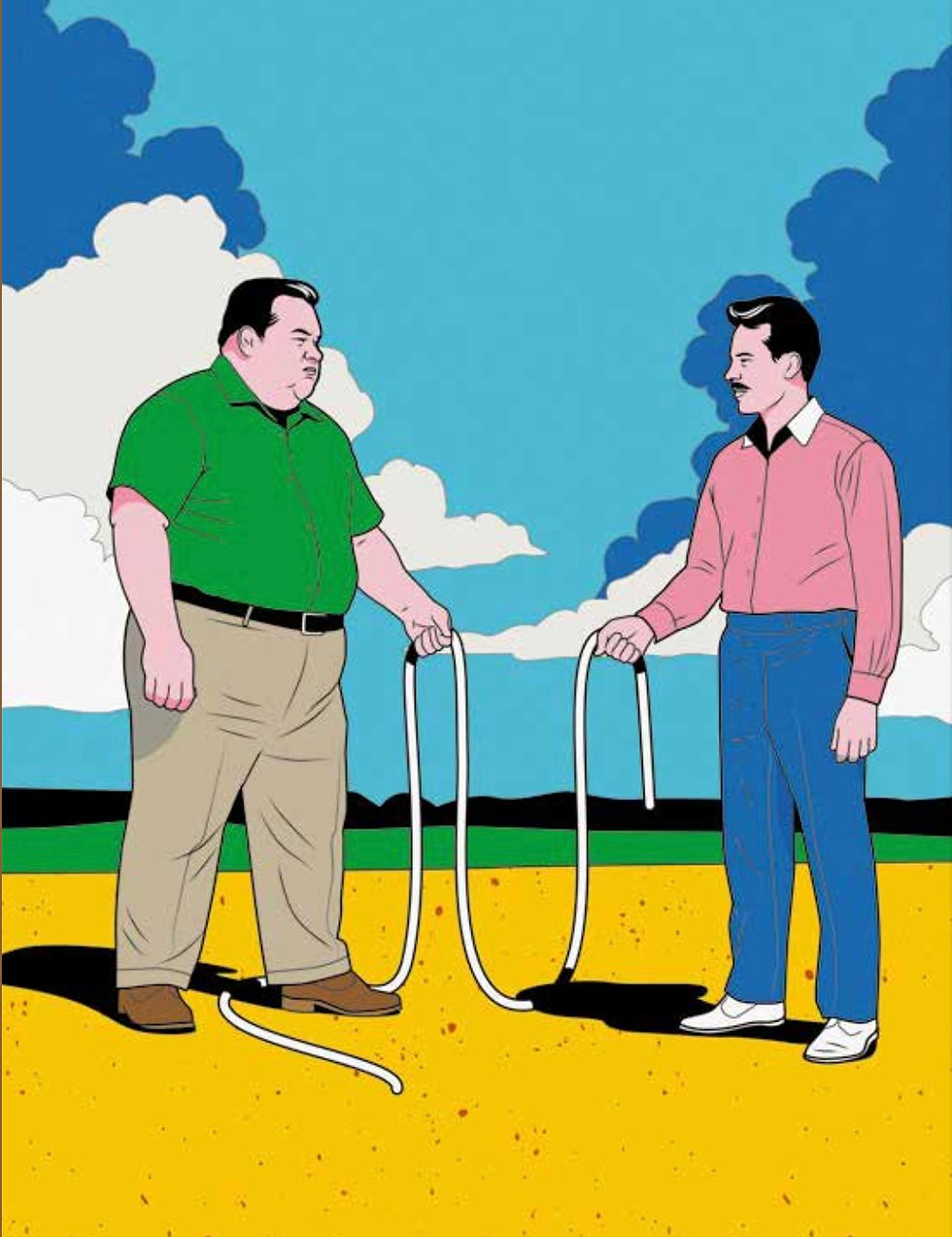
Hello, the second piece, that I've chosen comes from the second part of the book and deals with a particularly complicated subject, at least politically, in France. That's why I find it so relevant and important right now. The impossibility of forming political coalitions makes France an increasingly unique case in Europe, when even our Italian neighbors have recently managed to do so. The question remains: how can we achieve this when our politicians seem incapable of even imagining compromise with their "opponents"?
Part 2: Rethinking our ways of thinking
Sometimes thinking becomes tiring. Words become meaningless. Arguments lose their effectiveness before they even begin to convince. In a world saturated with opinions, it is thought itself, more than silence, that disappears.
We are surrounded by demands to react, like, comment, and denounce. While reflection takes time, we are desperately short of it. To keep up the pace, thought becomes compressed, rigid, and polarized. Nuances become suspect, hesitations are seen as weaknesses, and doubt as a danger. We are more indignant than we are understanding. We respond more than we ask questions.
When thought becomes narrow, the world becomes suffocating. Therefore, to rethink is already to breathe. This second part of the book invites us to pause. To reopen within ourselves a wider, slower, more vibrant space. It's not about being right against others, but about unlearning what confines us. About rediscovering a flexible, welcoming way of thinking, capable of wonder, of contradiction, of change.
Because thinking isn't just about expressing oneself. It's about connecting. It's about nurturing meaning, truth, and the bonds between people. It's about learning to listen to what is different from us. To engage in dialogue without seeking to dominate. To doubt without losing oneself.
It is about rediscovering the taste for reasoned debate, productive disagreement, and informed compromise.
The following chapters do not seek to impose a vision. They explore paths to intellectual emancipation. Criticism can be constructive. Conflict can be resolved through dialogue. A mistake can become a springboard. Loyalty can prove more subversive than betrayal.
This is about facts and fictions, pyramids and nuances, compromises and ambiguities. Above all, it is about that intimate discipline that is living thought: the kind that doubts without giving up, that resists without excluding, that seeks without wanting to close things off.
Rethinking our ways of thinking is not an intellectual luxury. It is perhaps the only lasting antidote to the confusion that surrounds us. It is the beginning of an invisible repair: that of the fragile fabric that binds us.

What if we rediscovered the art of compromise?
Compromise is often despised, yet it is one of the noblest gestures of democracy.
When a National Assembly is no longer capable of functioning sustainably, when laws must be passed repeatedly through the use of Article 49.3, when invective replaces debate, it means that a fundamental element of democratic functioning is lacking: the art of compromise. A democracy without a stable majority should logically gravitate towards a culture of coalition, negotiation, and power-sharing. Yet, in France, everything seems to happen as if the absence of an absolute majority prevents governance, instead of encouraging cooperation. In a country like ours, which sees itself as more revolutionary than reformist, compromise is a particularly devalued term at a time when radicalism seems to be gaining momentum. As if democracy could only function as a dominant bloc, instead of being reinvented through adjustment, dialogue, and the construction of shared solutions. This is what former union CFDT's General Secretary Laurent Berger clearly reminds us in his dialogue with Jean Viard, entitled *For a Society of Compromise* (2024). In it, he denounces the trap of a democracy transformed into a permanent confrontation, incapable of organizing disagreement, channeling tensions, or allowing for partial agreements on concrete projects. A democracy that has become accustomed to obstruction or strong-arming, as if these dead ends had become the norm. Yet, instead of viewing compromise as a weakness, couldn't we try to see it as a strength? A responsible way to act together in a world riddled with contradictions, divergent interests, and urgent issues to address?
COMPROMISE IS NOT GIVING IN
In the French collective imagination, the word "compromise" retains a pejorative connotation. It evokes renunciation, betrayal, and a loss of integrity. As if taking a step toward another necessarily amounted to betraying or denying oneself. This confusion has serious consequences, as it often prevents us from thinking of politics as a space of mediation rather than domination. Etymologically, however, the term comes from the Latin compromissum , "agreement by mutual promise," and in ancient Rome designated a peaceful method of conflict resolution. It is also at the origin of many fundamental agreements in human history, from peace treaties to democratic constitutions. Compromise is the civilized mechanism that makes possible the coexistence of different worldviews without descending into violence. But in France, this culture struggles to take root. As Laurent Berger and Jean Viard point out, our political tradition is marked by revolution, top-down management, centralization, and absolutes. We prefer ruptures to adjustments, divisions to rapprochements, ideological purity to the complexity of reality. Added to this is an institutional system that, by concentrating power in the hands of the executive, reduces the spaces for deliberation and makes it more difficult to find a balance between political forces. Compromise, however, is anything but a surrender.It does not mean giving in on the essentials, but recognizing that there are other legitimate viewpoints besides our own. It is not simply a consensus (agreement and consent of the majority), but the result of a negotiation process to integrate the other's perspective. Compromise is a constructive process where each party makes mutual concessions to reach an agreement that benefits everyone, while respecting each other's principles and values. However, it does not require abandoning one's own values, but rather invites us to accept that living together necessitates reciprocal adjustments. It is not opposed to self-respect; it is opposed to the arrogance of those who believe they alone possess the truth.
THE COURAGE TO COMPOSE
Many thinkers have theorized the importance of compromise in the construction, development, and maintenance of stable, just, and coherent societies. In Leviathan, Hobbes imagined a social contract where compromise between individuals and authority is necessary to avoid the state of nature characterized by a war of all against all. Locke saw compromise as the condition for the formation of a legitimate government, where the consent of the governed is paramount. Rousseau perceived it as a means of forging a general will, and Durkheim, like Hannah Arendt, demonstrated its necessity for maintaining order and solidarity in complex societies. For Paul Ricœur, compromise is first and foremost an act of courage. Courage to renounce, to sometimes go against one's own side, in the name of a higher common good. Courage, too, not to rely on a third party to resolve the conflict, but to take responsibility. Finally, we must have the courage to accept difference, because it is always easier to claim to possess the sole truth by establishing "non-negotiable principles" that exclude those who do not think like us. Everything begins with openness to dialogue, essential for reaching a compromise, as it allows for the exchange of ideas, mutual understanding, and the search for solutions acceptable to all parties involved. A compromise cannot be decreed, but is built step by step, through discussion, reciprocity, adjustment, and sometimes even pain. It presupposes a recognition of the legitimacy of those with whom we disagree, an acceptance of this disagreement, and yet the search for a common path. For Laurent Berger and Jean Viard, this capacity for compromise is vital today: firstly, because the political system no longer allows for absolute majorities, but also because the challenges we face are too complex to be addressed by a single political or ideological force. Faced with climate change, social inequalities, the transformation of work, and the energy and digital transitions, we need shared solutions, a clear direction, and active cooperation. This requires moving away from a logic of confrontation and towards one of co-creation.
THE BET ON A LIVING DEMOCRACY
Compromise, far from being a last resort, is a profoundly democratic act. It transforms conflict into a driving force, divergence into richness, and otherness into a resource. It is not about denying disagreements, but about framing them, making them productive. It is not about standardizing opinions, but about organizing their coexistence within a shared vision. What Laurent Berger calls a "society of compromise" is a society that provides itself with the means to engage in dialogue, to negotiate, and to build decisions together. A society where citizens are involved in the choices that concern them, where disagreements are not denied but debated, where agreements are not imposed but co-created. For him, "the logic of compromise is that of the transition between decivilization and recivilization ." This implies creating spaces for deliberation, allowing time for reflection, and encouraging cooperative practices at all levels, including within businesses, local communities, and associations. From this perspective, compromise becomes a gamble on collective intelligence. A gamble on our ability to talk to each other, to listen to each other, to stand together despite our differences. A gamble on a vibrant democracy, open to new paths, where negotiation takes precedence over legislation. Compromise is not a technique. It is a culture. A way of being in society. A fundamental political act. It does not replace convictions; it provides them with a framework for action. It does not dissolve conflicts; it tames them. It does not erase differences; it makes them livable. And what if, instead of waiting for a providential leader, we are learning to become artisans of the common good again? It is time to replace a top-down political approach with a horizontal one. We must learn to do politics without politicians, within all forms of organization, by harnessing the dynamism of the non-profit sector. We must rekindle the desire to act by helping everyone rediscover meaning and a sense of community. Because politics cannot be the sole domain of politicians. Politics is all of us. All of us together.
"Compromise is always
weak and revocable,
but it's the only way
to aim for the good
common. "
PAUL RICŒUR, French philosopher (1913-2015)


Comments